

Brazil Strengthens Global Leadership in the Stone Industry and Eyes a New Decade of Value-Added Growth

For decades, Brazil has stood out as one of the world’s leading players in the natural stone industry. In 2024, the country reaffirmed its position by exporting US$ 1.263 billion in marble, granite, quartzite, and other natural stones, securing 5th place in the global ranking of exporters. Traditionally rooted in raw extraction, the sector is now heavily investing in industrialization and value addition as a strategy for international competitiveness.
According to data from Centrorochas, over 1,200 varieties of stones are commercially explored in Brazil, with a clear highlight on Espírito Santo, which accounts for over 82% of national stone exports. The United States remains the top destination, absorbing more than half of Brazil’s total exports in 2024, followed by China, Italy, and Mexico.
Brazilian Natural Stone Exports (2021–2024):
Year | Valor Exportado (US$ bilhões) |
2021 | 1,34 |
2022 | 1,16 |
2023 | 1,12 |
2024 | 1,263 |
Source: Centrorochas / ComexStat
Differentiation Through Geological Diversity
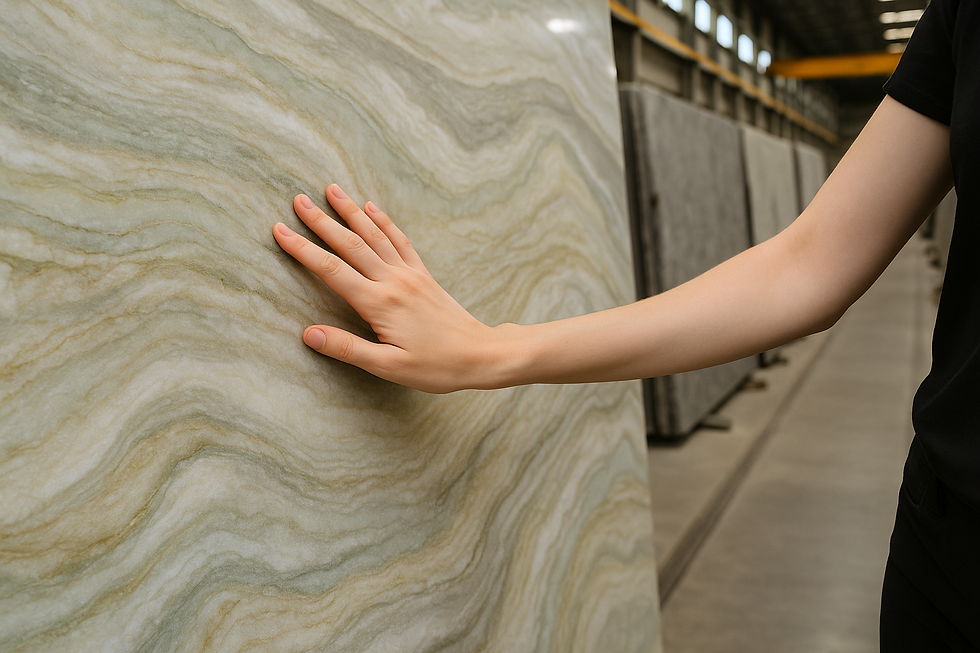
Few countries in the world possess the geological diversity of Brazil. Stones such as Taj Mahal quartzite, Branco Ceará granite, and Venom quartzite have become staples in high-end projects across the United States, Europe, and the Middle East. This varied portfolio has been key to penetrating new markets, alongside the technological advancement of Brazil’s industrial infrastructure, which now features multi-wire saws, high-performance resins, and automated polishing lines.
Additionally, the industry has been expanding its offering of finished products — including countertops, flooring, sinks, and pre-cut panels — aiming to increase the value per exported square meter. This shift has a direct impact on international competitiveness, especially in the face of rising competition from synthetic materials like porcelain and engineered quartz surfaces.
Outlook and Internationalization
The sector’s internationalization has gained fresh momentum with the launch of Marmomac Brazil, to be held in São Paulo in February 2025. This international trade fair — organized by Veronafiere, the promoter of the traditional Marmomac in Verona — is expected to bring together over 200 exhibitors and 15,000 visitors from 60 countries. According to analysts, the event marks a new era for the industry: less dependency on foreign expos and greater appreciation for Brazil’s domestic production chain.
Top Importers of Brazilian Stone in 2024:
🇺🇸 USA – US$ 711.1 million
🇨🇳 China – US$ 218.5 million
🇮🇹 Itália – US$ 82.8 million
🇲🇽 México – US$ 30.3 million
🇨🇱 Chile – US$ 25.9 million
Source: ComexStat / Centrorochas
Challenges: Logistics, Trade Classification, and Global Perception
Despite progress, the industry still faces bottlenecks. Underdeveloped port infrastructure, exchange rate volatility, and complex taxation systems continue to hinder sustainable growth. Additionally, the lack of standardized stone nomenclature — with frequent confusion between marble, granite, and quartzite — recently triggered commercial tensions with the U.S., which considered tariffs on misclassified Brazilian stone labeled as “granite.”
In an interview with Forbes, experts emphasized the urgency of coordinated actions among industry players, government bodies, and trade organizations to educate the international market on the specific qualities of Brazilian stone — a geological, cultural, and economic asset of strategic relevance.
Conclusion
More than a supplier of raw blocks and slabs, Brazil is solidifying its role as a global leader in the stone industry. With innovation, commercial intelligence, and investment in design, the country has the potential to double its share in the finished product market in the coming years. To achieve this, it will be essential to strengthen international engagement and continue investing in the sophistication of the production chain.
The challenge of the next decade is not just to extract — but to transform.




Comments